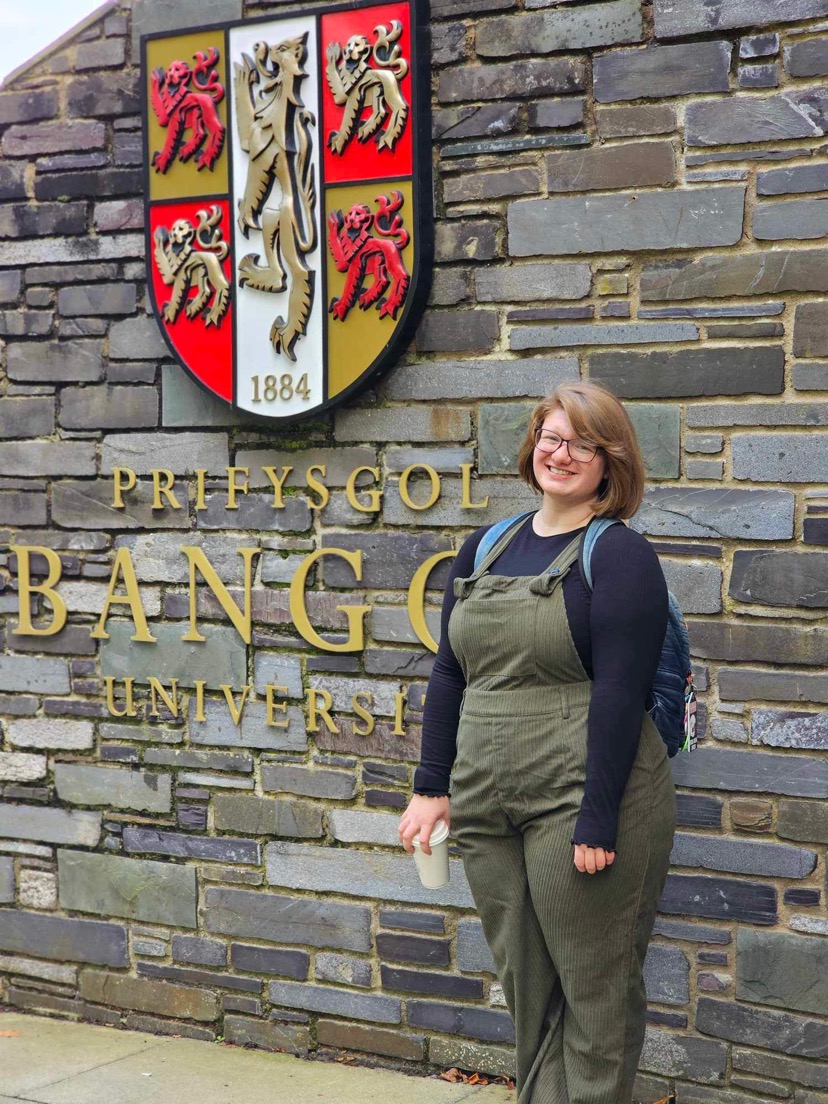
In October, a small group from the GwyrddNi community embarked on a residential Intermediate/ Advanced Welsh course in Nant Gwrtheyrn, which was generously provided free of charge by the Nant.
Over the week, students had the opportunity to hear a private concert from Gwilym Bowen Rhys, to visit Yr Orsaf to hear about their work, and to hear Steve Eaves talking about “ecolinguistics” – as well as the opportunity to learn and practice a lot of Welsh!

Nina, our Community Facilitator for Bro Ffestiniog, shares her experiences and insights in this blog:

NINA: If you want to change or adapt behaviour – you need to increase motivation, and remove barriers. As a Welsh language learner, and the only GwyrddNi employee learning Welsh as a second language, I wanted a shake-up around learning the language. But I hadn’t really considered that addressing motivation and barriers would be an important part of doing that.
Could just 4.5 days of immersion really have a life-changing effect? I went with as open a mind as I could manage, but I couldn’t ignore the feeling that it wouldn’t be a magic pill.
By the end of the week, though, I began to see my earlier motivation in a new light. I hadn’t realised that my drive to learn Welsh had become mostly about building social and economic capital.
Socially, I want people to like me, to want to talk to me, to feel we share the same world, understand each other. Economically, I want to be good at my job and a useful team member. These still stand as motivations. But I hadn’t realised there was a lack of spirit in them. A lack of depth.

The week in Nant Gwrtheyrn gave me a glimpse at a deeper kind of motivation- like the deep belly of the earth- a moving fiery lava undercurrent that spans many more generations and species than my silly little self-centred moment on this planet. That’s something to get up in the morning for.
One of the biggest barriers I’d struggled with was believing that meaningful relationships wouldn’t form without fluency, without access to all the right words. Those jerky, miss-tensed conversations, maybe half understood at best, couldn’t possibly be enough to build friendship upon. But they are.
The seven of us spoke Welsh through breakfast, lunch, and dinner, as we walked to class, to the beach, dipped in the sea, at the pub. I couldn’t tell you that the quality of our interpersonal relationships was any the worse for lack of fluency. In fact, I would say it was better. We gave each other time, space, compassion and encouragement.

Another barrier I had was this nagging doubt that I could ever achieve real depth and fluency. I’ve likened language learning to picking up a violin for the first time at the age of 35, with maybe just a little musical background. You’d never expect to be joining the Royal Philharmonic after a few years. Maybe the best I could hope for was to be the fully grown, grey haired adult sat awkwardly in the school orchestra and still hitting some dud notes. And this was all caught up with the idea that translation from one language to another was even truly achievable.
My week at Nant Gwrtheyrn made me realize the barrier didn’t need to be there at all. Instead of thinking about language learning as a journey with “ups and downs” (maybe leading nowhere), I began to see it as looking through a window to a new view, a different perspective on life and the world. It was like gaining sight where there had been none. I thought of the delicate work of restoring Medieval wall paintings: unveiling colours and details previously hidden.
When I viewed learning Welsh—a minoritized language—as a chance to unlock these hidden worlds, I felt empowered by what I’d learned so far rather than reaching endlessly for the impossible. I saw that what I was already doing – clearing a brand new window pane and appreciating the new shapes and colours I could see, however foggy, was a good thing. That I’m an adventurer, an explorer, an archaeologist. That shift worked like a pencil eraser on a rigid, drawn fence.
Sure, I’ve learned some taswn i and baswn i, a “cyntaf ar ddeg ar hugain” and more. But it’s the motivation lava and fence-free landscape that is helping me look towards the future.

GwyrddNi is a community-based, community-led climate action movement that brings people together in five areas of Gwynedd to discuss, share and act locally to tackle climate change.
If you want to be part of co-creating greener, more sustainable and resilient communities – get in touch – or click the button below to let us know how you’d like to be involved. We will get back to you and connect to you to most appropriate person/people!